Case study: scenario-based safety compliance eLearning
Workplace Violence Prevention
Turning a required safety plan into decisions staff can make in seconds, often with children in the room.
Instructional Designer
My role
A statewide early childhood provider
Organization
Teachers, assistant teachers, center directors
Audience
Safety team, Human Resources
Partners
Articulate Rise 360, Google Veo, ChatGPT
Tools
Same parent. Same classroom. One line crossed.
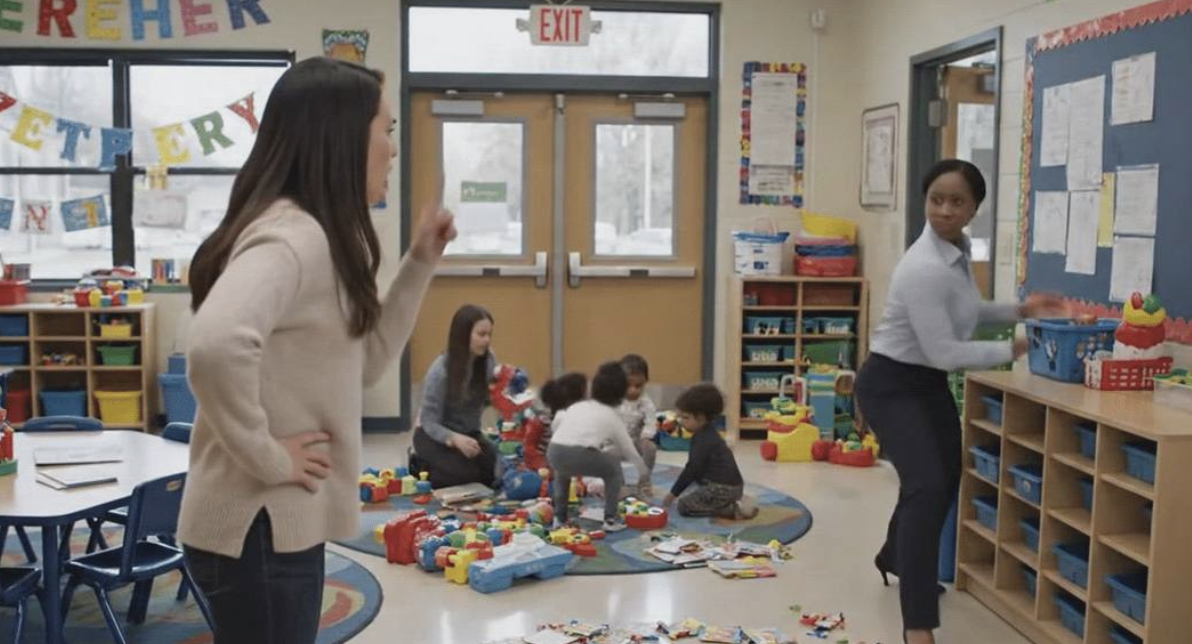
Warning sign
Verbal frustration. The teacher stays calm, moves near the exit, suggests stepping aside, and documents it.
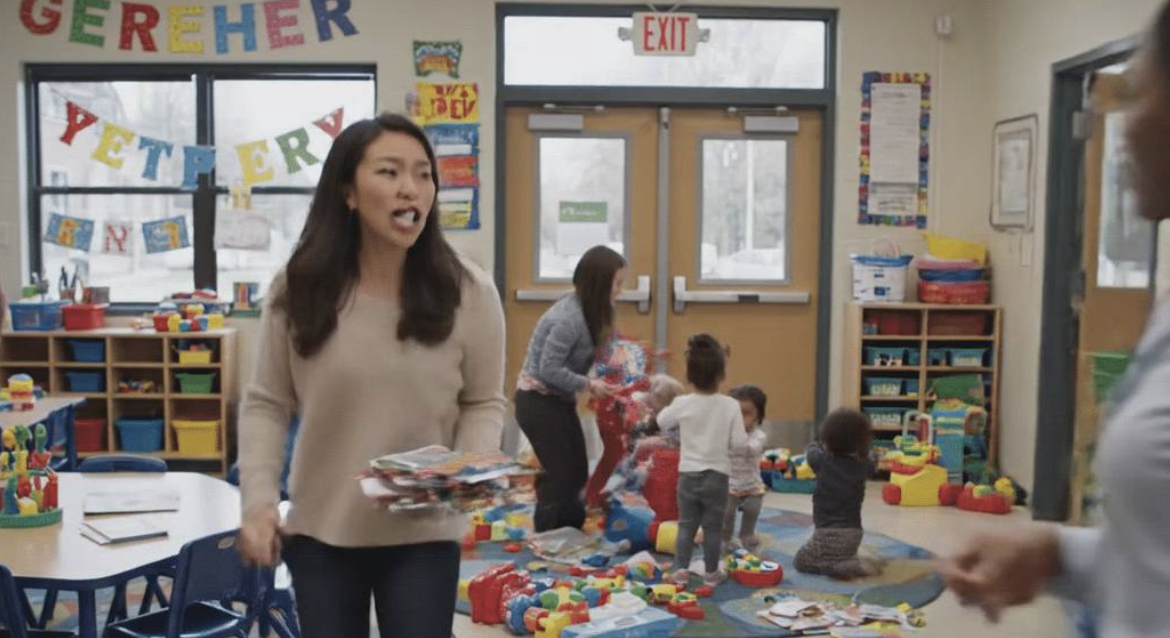
Workplace Violence
The parent throws objects. Now the teacher sets a limit, moves toward the exit, and has a colleague contact authorities.
The project at a glance
1. Context
California's SB 553 required a Workplace Violence Prevention Plan and staff training on it.
2. Gap
Staff needed to act on the plan in the moment, not just know it existed.
3. Intervention
A 25-minute scenario-based course built around one call: warning sign or workplace violence?
4. Measure
Correct calls across 15 practice decisions in the course.
The challenge
California's SB 553 requires most employers to keep a written Workplace Violence Prevention Plan and to train employees on it. The provider had its plan. Staff across its centers needed to know what to do with it.
The job makes this hard. Teachers face frustrated parents at drop-off and pick-up, sometimes work alone or in isolated areas, and stay responsible for children while a situation unfolds. Most warning signs are quiet: a coworker who withdraws, a new assistant who's being belittled.
Staff had to decide quickly whether something was a warning sign to document or an incident to report now, and which channel to use.
A policy on file doesn't protect anyone. A practiced decision does.
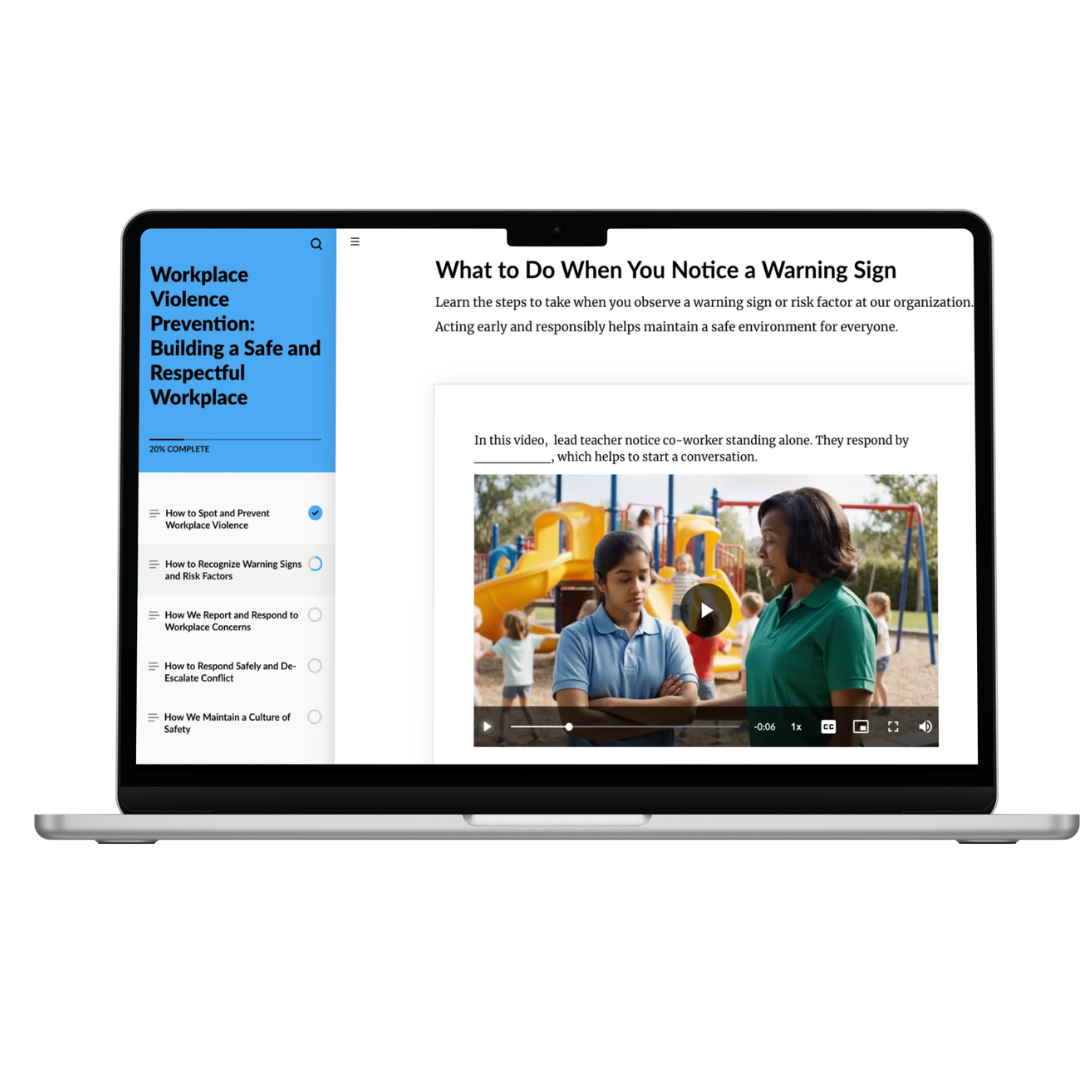
Five lessons in the order staff meet a real situation: understand it, notice it early, report it, respond to it, then keep the system working. Each type of practice is built for a different part of that decision.
The course

Paired videos and sorting
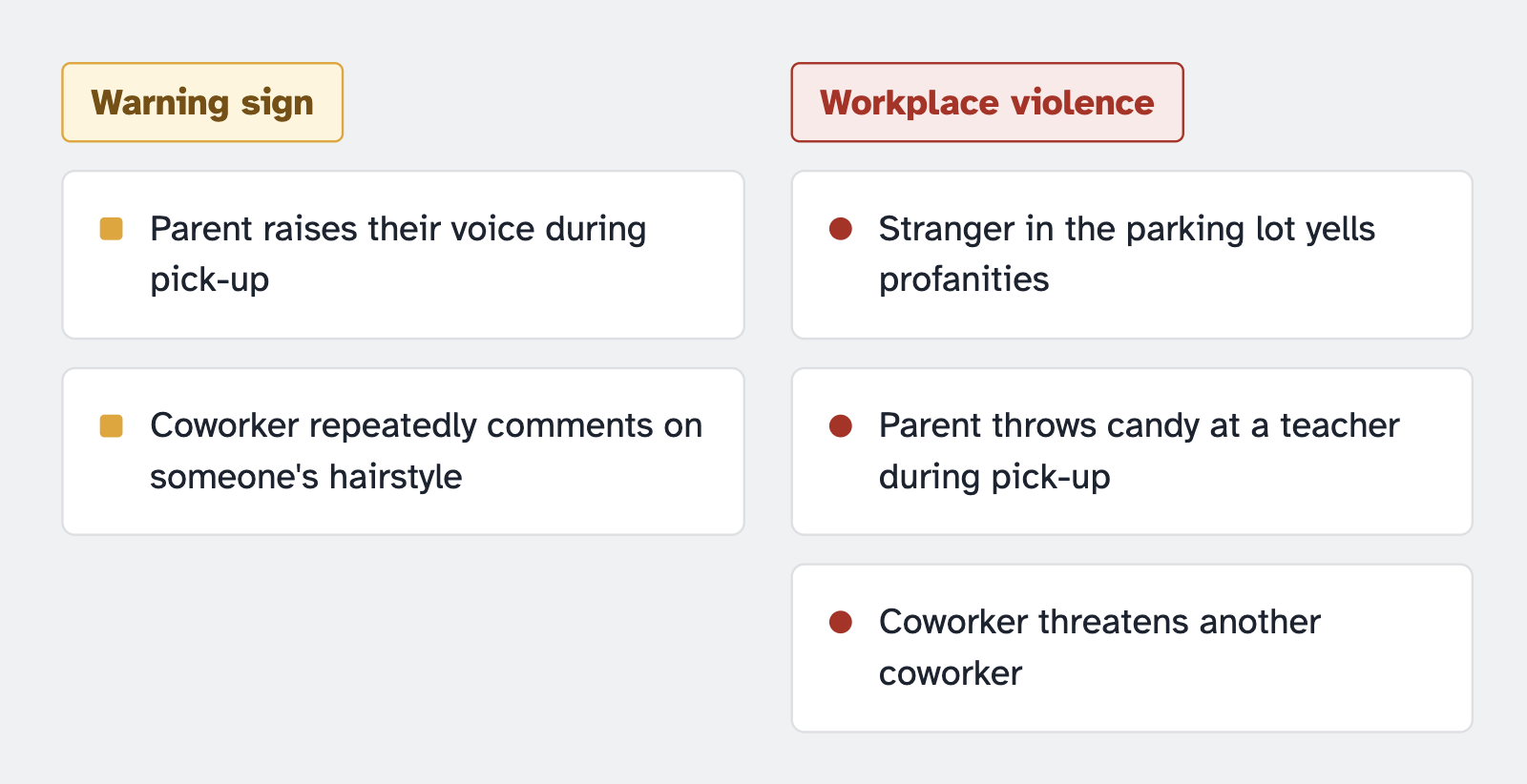
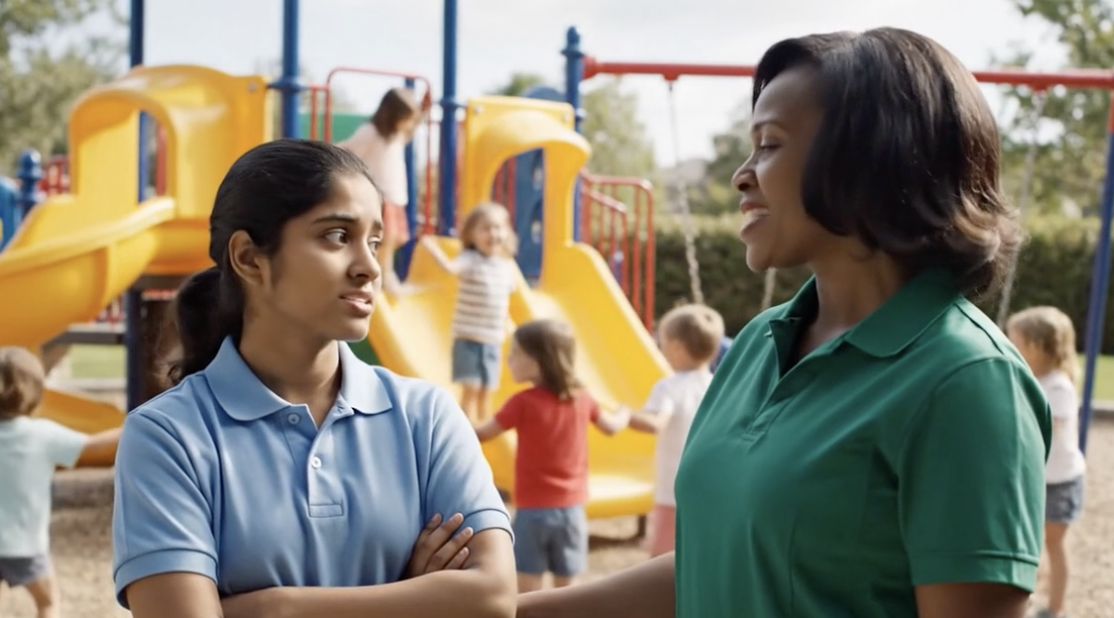
Learners watch the same parent in two short videos, name what they saw, and get feedback that models the response. Two sorting activities follow: warning sign or violence, then document or report now.
Two voice-narrated scenarios from a normal day. In one, a lead teacher named Marta keeps hearing a coworker belittle the new assistant during diapering.
Choosing "do nothing" or "praise her in public" shows why those fall short. The strongest choice is to document the pattern and escalate to the Center Director.
Branching scenarios

Procedures built for looking up
Reporting steps, the investigation timeline, and emergency response are step-by-step process interactions. Reporting channels are flashcards that pair each situation with the right contact, so the course works as a reference after the first pass.
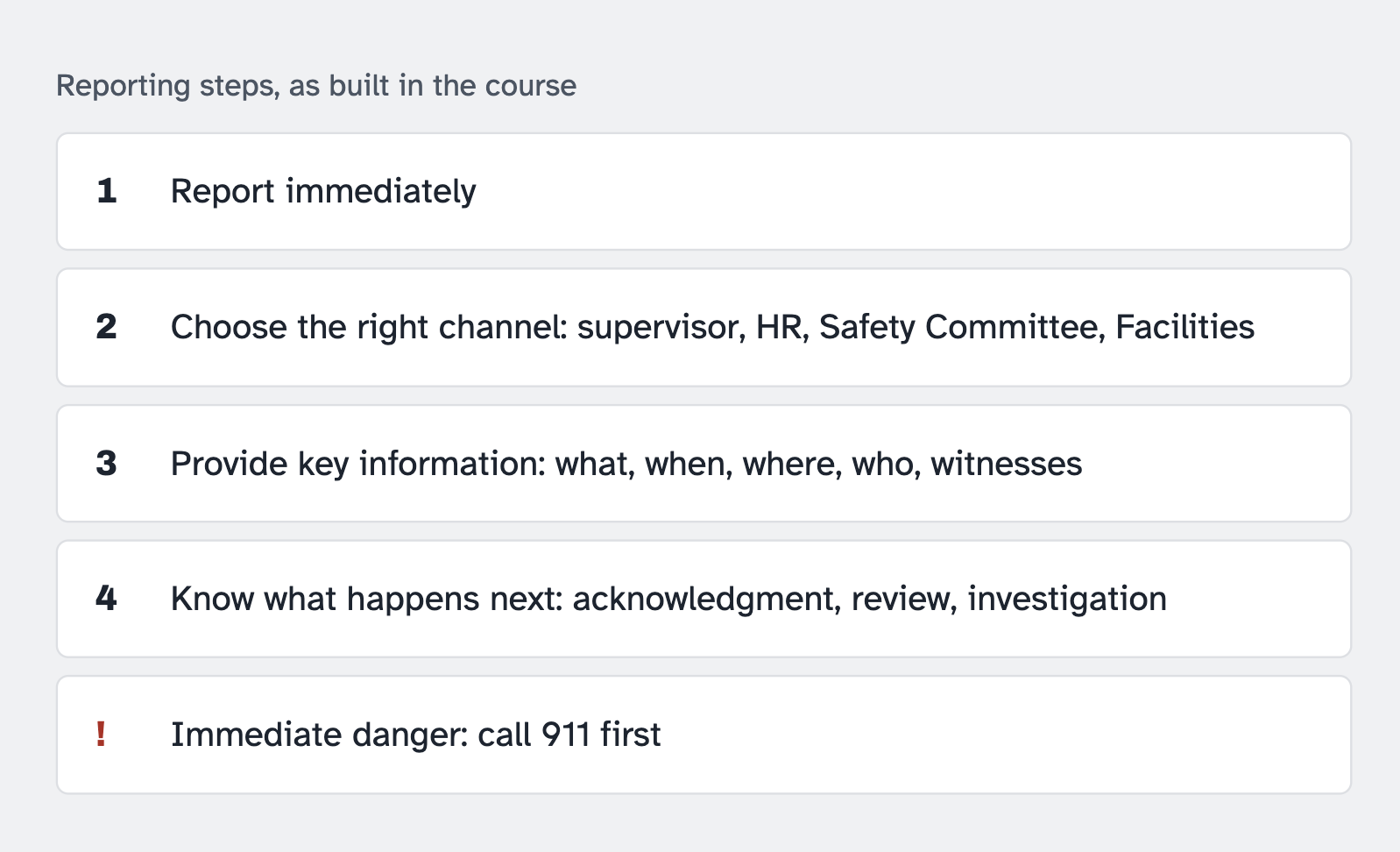
The design decision: one skill, one question
Compliance courses usually walk through the policy section by section. But the hardest moment for staff isn't knowing what to do in an emergency. It's deciding whether they're in one.
I built the whole course around that call, "warning sign or workplace violence?", because every step after it depends on getting it right.
The cascading-goals session used one real thread, kindergarten readiness, so staff could see their daily work connect all the way up.
How the approach shifted
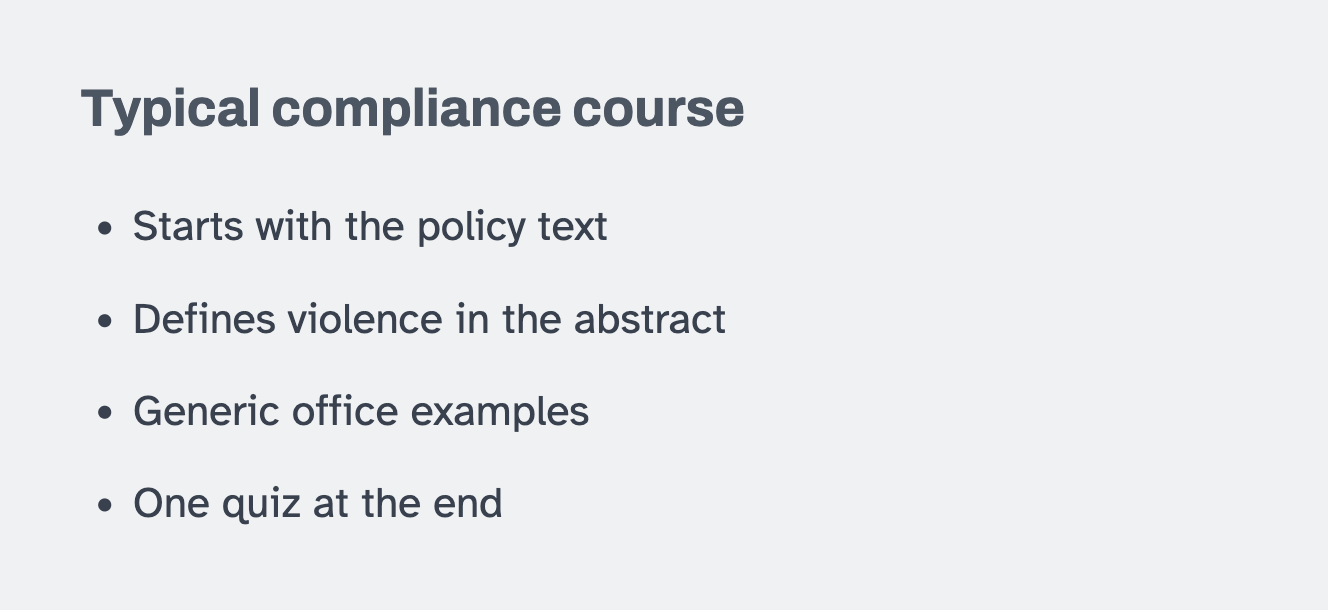
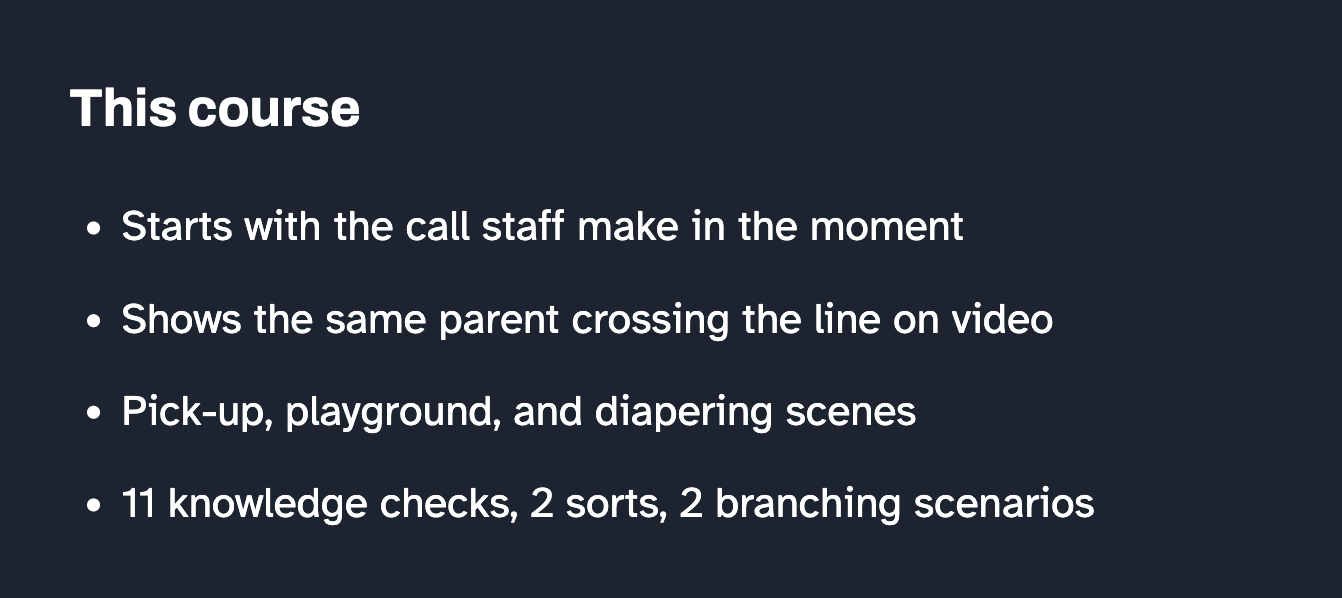
The course sits where two departments meet. Every procedure, channel, and promise in it had to match what each team would actually do when a report came in.
Built with Safety and HR
Safety team
The WVPP, its definitions, and the four types of workplace violence
Emergency procedures: alerts, lockdown, evacuation, drills
The Safety Committee and the Violent Incident Log
Human Resources
Reporting channels and confidentiality
The investigation process, from acknowledgment to close
No retaliation and support after an incident
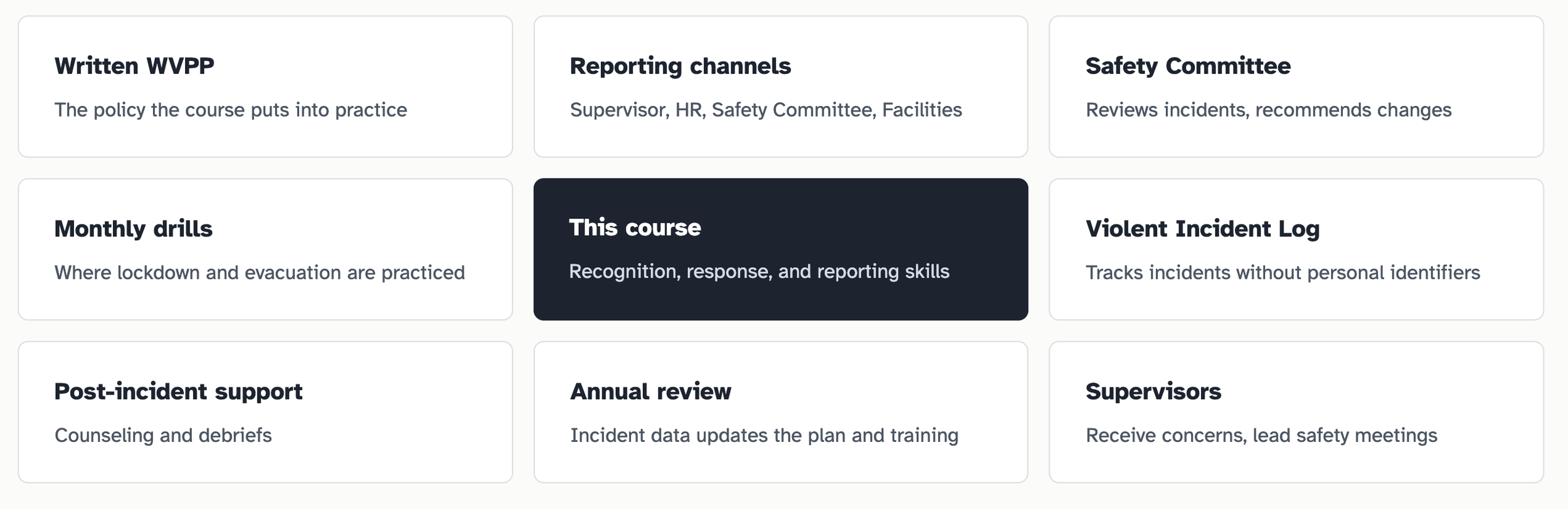
A course can't keep a workplace safe on its own. This one sends staff into the rest of the system: the people, logs, and drills they'll rely on afterward.
Training is one part of the plan
Real scenes, no cameras in classrooms
I produced the video scenes with Google Veo and the scenario art with ChatGPT. Filming in real centers would have put children on camera and asked staff to act out conflict.
Every video has captions, and scenario narration is paired with on-screen text.